Blog Post
From “I’ll Remember That” to Your Own Vocabulary List
Torben Ziegler
October 28, 2026
Turn useful expressions from series, conversations, and articles into a personal vocabulary list, then practice them in Fluently.

You’re watching a series in Spanish when a useful expression comes up. You understand it from the scene and think: I should remember that.
A few days later, you want to use it in a conversation. You can remember the scene, but the words are gone.
That moment is a good starting point for a personal vocabulary list.
Start With Something You Actually Want to Say
When you encounter unfamiliar words, it’s tempting to collect all of them. Every word feels like something you should know.
But a useful list can start with a smaller question:
Would I want to use this myself?
Maybe you hear someone explain that they’re running late. Maybe an article contains a phrase that would help you describe your work. Maybe a conversation reveals a gap: you know exactly what you mean, but you don’t have the words for it yet.
Those are good candidates for your list. You already have a reason to learn them.
Keep Enough Context to Make the Word Useful
Imagine hearing me di cuenta de que… in a Spanish series.
You could save the verb darse cuenta with the meaning “to realize.” But saving a short phrase can give you something more concrete to practice:
Me di cuenta de que era demasiado tarde.
I realized it was too late.
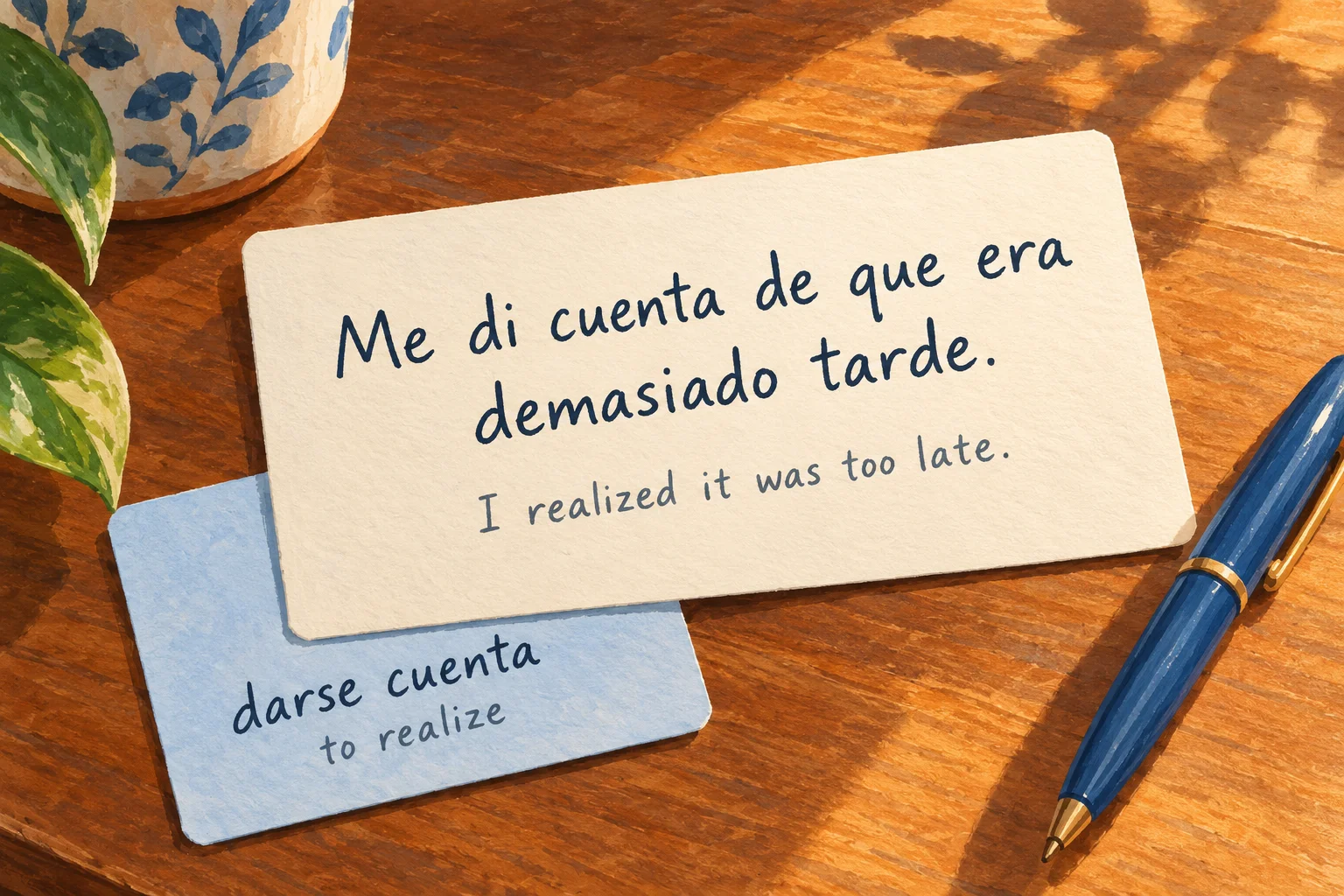
The example shows how the expression fits into a sentence. Later, you can adapt it to something you want to say.
You don’t need a long explanation for every entry. Keep enough context that your future self understands why you saved it.
Give the Words a Home in Fluently
Create a list in your Library with a name that makes sense to you.
“Spanish Words” works, but something more specific can make it easier to choose what to practice:
- Expressions from the series I’m watching
- Things I wanted to say this week
- Spanish for my next trip
Start with a handful of entries. You can add more as you encounter them.
The list doesn’t need to be complete before it becomes useful. It just needs to contain something worth coming back to.
Turn the List Into a Practice Session
Saving an expression gives you a place to find it. Practice gives you a chance to try remembering it.
Open your list in Fluently and start a session. Before revealing the answer, take a moment to think of the word or phrase yourself. Then use Again, Almost, or Nailed it to rate how well you remembered it.
If you’ve just added several entries, New words gives you a way to focus on those additions. When certain expressions keep tripping you up, Hard words lets you spend a session on them.
You don’t have to work through everything at once. Pick a session that fits the time and attention you have.
Bring It Back Into Your Life
After practicing, look for an opportunity to use one of your expressions.
Write a sentence about your day. Work it into a message. Try saying it aloud in a different context. If you’re learning me di cuenta de que…, finish that sentence with something you recently realized.
You can also revise your list as you go. An example that seemed clear when you saved it might need a better translation. A word you expected to use might turn out to be less relevant.
Your list can change with your learning.
Start With the Next Expression
The next time you catch yourself thinking I’ll remember that, take a moment to save it.
Keep the meaning, add a useful example, and put it somewhere you’ll return to. Then give yourself a chance to recall it in practice and use it outside the app.
That’s the idea behind personal vocabulary in Fluently: building a collection from the language you encounter and the things you want to say.